


Plastic components fail. Production lines stop. Quality audits reveal unexpected defects. When something goes wrong with a polymer part — whether it’s a discolored housing, a brittle connector, or a batch of recycled material that doesn’t perform as expected — the first question is always the same: what exactly is this material, and what’s in it?
FTIR spectroscopy (Fourier Transform Infrared Spectroscopy) answers that question faster and more reliably than almost any other analytical technique available today.
What Is FTIR Spectroscopy?
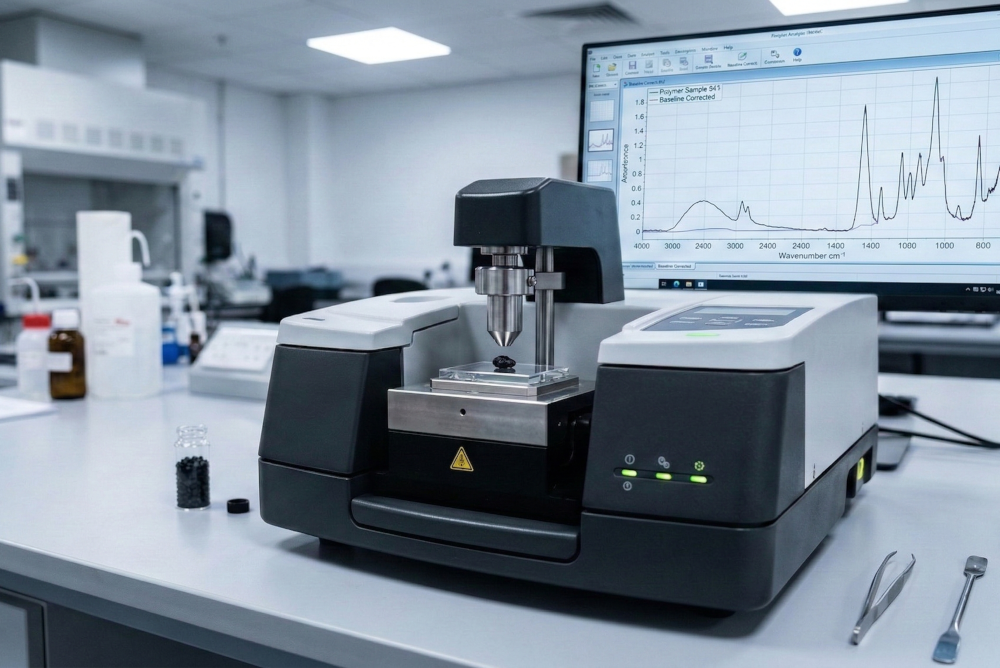
FTIR is a non-destructive analytical method that identifies chemical compounds by measuring how a material absorbs infrared light. Every polymer — polyethylene, polypropylene, ABS, PET, nylon, and hundreds of others — has a unique infrared absorption pattern, essentially a molecular fingerprint. When an unknown sample is analyzed, its spectrum is compared against reference libraries containing thousands of known materials, enabling precise identification within minutes.
The technique requires minimal sample preparation, works on solids, films, powders, and liquids, and does not damage the specimen. Established procedures are defined under internationally recognized standards — including ASTM E168, ASTM E1252 for general infrared spectroscopic analysis, and ASTM D5477 specifically for the identification of polymer layers and inclusions by FT-IR microspectroscopy — ensuring that results are reproducible, defensible, and audit-ready.
Polymer Identification in Under 5 Minutes
One of FTIR’s most practical advantages for manufacturers is speed. Identifying the exact polymer type in a component typically takes less than five minutes from sample placement to result.
This matters more than it might seem. Consider a scenario common in electronics manufacturing: a supplier delivers a batch of plastic enclosures labeled as a PC/ABS blend. Production goes smoothly until heat resistance tests begin showing inconsistent results. FTIR analysis of several components quickly reveals that part of the batch is actually made from standard ABS without the polycarbonate component — a material swap that would never be visible to the naked eye but has significant implications for thermal and mechanical performance.
Without rapid identification capability, such discrepancies can travel deep into the production process or, worse, into the field. FTIR is equally effective for verifying incoming raw materials before they ever reach production. Rather than relying solely on supplier declarations and certificates, quality managers can run spot checks on resin pellets, masterbatches, or semi-finished parts to confirm the material is exactly what was ordered.
Detecting Contaminants: Black Specks, Degraded Material, and Cross-Contamination
Contamination is one of the most persistent quality challenges in polymer processing. In electronics and appliance manufacturing, where surface finish, electrical properties, and dimensional stability are all critical, even trace contamination can cause part rejection, assembly failures, or field returns.
FTIR excels at identifying the chemical nature of contaminants, which is essential for tracing their source and eliminating them. The technique can reliably detect contaminants at concentrations down to approximately 100 ppm, making it sensitive enough for most production quality scenarios.
Black specks are a classic production headache. These small dark particles embedded in or on the surface of molded parts can originate from several different sources: thermally degraded polymer, carbonized material from a dirty screw or barrel, cross-contamination from a previous production run, or external particulate contamination. Visually, they all look the same. Chemically, they are often quite different. FTIR analysis of isolated black specks — performed according to ASTM D5477 microspectroscopy protocols — can distinguish between degraded versions of the base polymer, incompatible foreign polymers, or non-polymeric residues, pointing directly to where in the process the problem originates.
Cross-contamination between polymer grades is another area where FTIR provides clear value. In facilities that process multiple materials on shared equipment, residual material from previous runs can mix into subsequent batches. Even small amounts of an incompatible polymer — say, POM contaminating a PA6 run — can cause surface defects, reduced weld line strength, or processing instability. FTIR can detect these contaminants at low concentrations, allowing quality teams to act before affected material reaches assembly.
Oils, release agents, and processing aids that remain on component surfaces or migrate into the bulk material can also be detected. These are particularly relevant in electronics, where surface contamination can interfere with adhesive bonding, painting, or ultrasonic welding.
Verifying Recycled and Regrind Materials
The growing use of recycled and regrind polymers in manufacturing introduces a level of material variability that virgin resins simply do not carry. Regrind in particular — reprocessed material from production scrap or rejected parts — may have been exposed to thermal stress, moisture, or contamination during its previous processing cycle, all of which can alter its chemical profile in ways that are not visible and not captured by standard supplier documentation.
FTIR provides a fast and reliable way to verify that recycled or regrind material matches the expected polymer type and does not carry contaminants picked up during the recycling or reprocessing cycle. Combined with the EU regulatory push toward greater recycled content transparency — the new EU Packaging Regulation, in force since February 2025, introduces mandatory recycled content targets and documentation requirements — having a documented analytical protocol for incoming recycled material is becoming both a quality and a compliance priority for manufacturers.
Where FTIR Fits in Your Quality System
FTIR is most powerful when integrated into a broader quality control workflow rather than used only reactively when problems arise. The most effective applications fall into three categories:
- Incoming material verification — confirming polymer type and detecting contaminants in raw materials, regrind, or recycled content before they enter production
- In-process quality checks — investigating defects such as surface anomalies, inclusions, or unexpected part behavior as they appear on the production floor
- Failure analysis — identifying the root cause of field returns, warranty claims, or batch rejections where material composition or contamination is suspected
For quality managers dealing with multiple suppliers, complex material portfolios, or increasing recycled content obligations, having FTIR results as part of the material documentation record also provides a useful layer of traceability and regulatory audit readiness.
Understanding FTIR’s Limitations
FTIR is a powerful screening and identification tool, but it works best as part of a broader analytical approach. Its reliable detection threshold is around 100 ppm for most contaminants, which covers the majority of production quality scenarios — but trace-level impurities may require complementary techniques. It is also worth noting that certain inorganic pigments — notably carbon black and TiO₂, both common in electronics components — can interfere with or partially mask FTIR signals, making peak interpretation more complex and, in some cases, requiring additional analysis.
FTIR does not directly measure mechanical properties, molecular weight, or additive concentration levels. For a complete characterization of a problem material — particularly in complex failure cases — FTIR results are often combined with DSC (Differential Scanning Calorimetry), TGA (Thermogravimetric Analysis), or GC-MS. Knowing which technique to apply, and how to interpret results in context, is where laboratory expertise adds the most value.
How Our Laboratory Can Help Your Business
If you are dealing with polymer identification questions, contamination issues, recycled material qualification, or incoming material verification — including compliance with the EU Regulation requirements on recycled content — our laboratory offers FTIR spectroscopy as part of a comprehensive suite of plastic analysis services.
We work with electronics manufacturers, appliance producers, component suppliers, and R&D teams who need fast, accurate, and technically sound answers to their material questions. Whether you are investigating a production defect, qualifying a new supplier, verifying recycled content, or building the documentation trail your compliance team will need, our analysts can support you with the right protocol and a clear, actionable report.
Contact us to discuss your specific requirements. We will identify the most appropriate analysis for your situation and provide results you can use with confidence.