


Mechanical Tests
Evaluating the resistance and performance of plastic materials
Mechanical tests are fundamental for determining the behavior of plastic materials under the action of external forces. These analyses provide crucial information on strength, rigidity, ductility, and other mechanical properties, allowing to assess the suitability of a material for specific applications and predicting its performance over time.
Through the application of different techniques and methodologies, mechanical tests simulate the stresses to which materials may be subjected during use, providing essential data for quality control, preventing malfunctions and predicting the lifespan of materials in specific usage conditions.
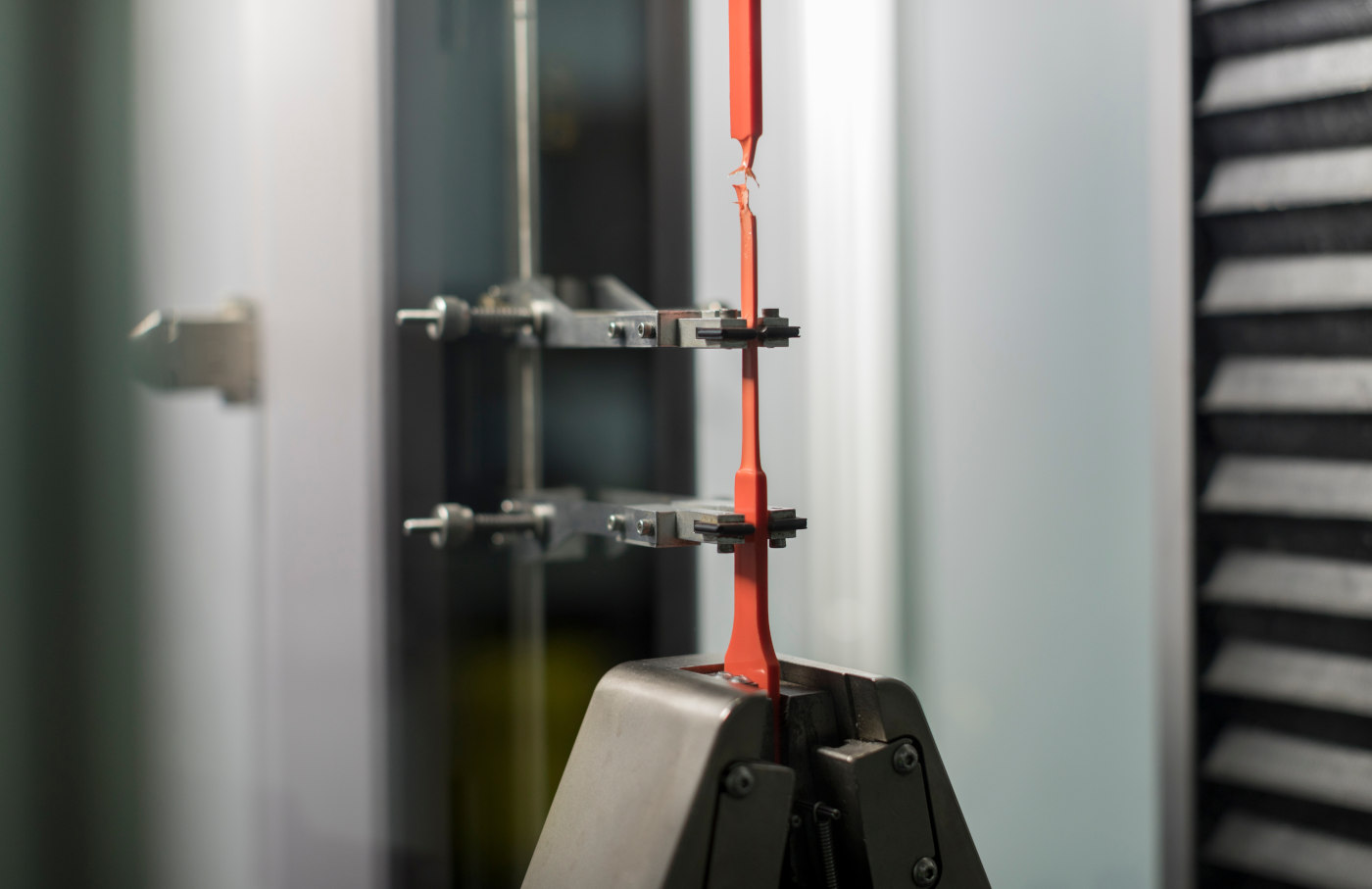
Mechanical tests performed by Plastanalisi
In our laboratory, we have state-of-the-art equipment and highly qualified personnel to perform a wide range of mechanical tests, including:
Tensile, Flexural, and Compression Tests
The strength of materials to different types of stress is evaluated, determining parameters such as breaking load, Young’s modulus, elongation at break, and compressive strength.
Shore A/D Hardness Tests (ISO 868)
This test measures the resistance of the plastic material against an indenter’s penetration, providing information on its surface hardness. The Shore A scale is used for softer materials, while the Shore D scale is suitable for more rigid materials.
Flexural Tests (ISO 178)
Flexural tests are used to determine the behavior of materials under flexural load, measuring parameters such as flexural modulus and flexural strength.
Determination of Ring Stiffness (ISO 9969)
The stiffness of plastic tubes or rings is evaluated, an important property for applications such as conduits or containers.
Tensile Tests (ISO 527)
We perform standardized tensile tests to determine the tensile properties of materials, such as modulus of elasticity, tensile strength, and elongation at break.
Izod Impact Resistance (ISO 180)
The impact resistance of a material is evaluated, measuring the energy absorbed by a notched specimen subjected to a pendulum impact.
Our Equipment
To ensure maximum precision and reliability of results, our laboratory is equipped with state-of-the-art instrumentation:
- Dynamometer: A versatile instrument for performing tensile and flexural tests, capable of accurately measuring applied forces and displacements.
- Dynamometer with Climatic Chamber: Our laboratory features a dynamometer equipped with a climatic chamber that allows for performing tensile and flexural tests at temperatures from -40°C to +200°C, studying the behavior of the material under mechanical stress at different non-ambient temperatures.
- Pendulum (IZOD): A device for performing Izod impact resistance tests, equipped with a pendulum that strikes the specimen with a specific energy.
- Durometer: An instrument for measuring the hardness of materials, capable of providing precise and repeatable results.
Useful Resources
DSC vs. TGA: Which Thermal Analysis Do You Need?
A plastic component changes shape during use. A molded part shows an unexpected melting peak. A supplier says a compound contains 30% glass fiber, but the incoming material behaves...

Polypropylene (PP) Impact Failure: Why Parts Shatter in the Cold
A plastic housing that survives years of handling on a factory floor can crack the instant it is dropped on a loading dock in January. For engineers working with polypropylene, this is not...

Plastanalisi Closed for Summer Break
Summer is here, and we’re taking a short break! Our office will be closed from Monday, August 3rd through Friday, August 21st. We’ll be back in action and returning to normal operations on...
Contact a Plastanalisi Technician
Do you need to analyze a plastic product? You are just a few clicks away from finding the answer to all your questions.