


Polymers are not static materials. From the moment a plastic component leaves the production line, it begins interacting with its environment: absorbing moisture, contracting in the cold, softening in the heat. Most standard tensile tests, however, are performed at 23°C and 50% relative humidity, a controlled condition that tells you relatively little about how a part will behave inside a car engine bay in July or in a medical device stored in a tropical climate.
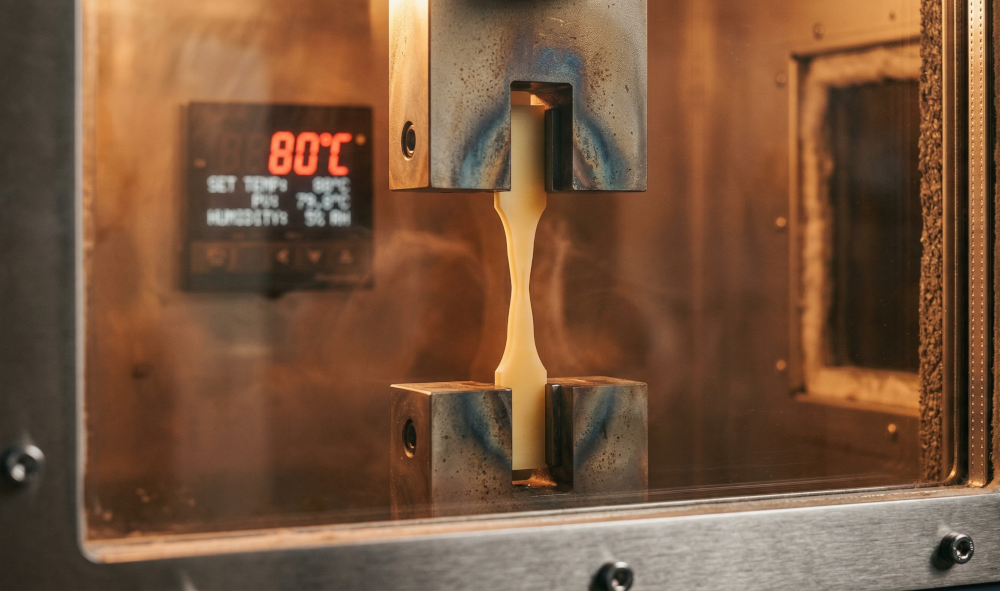
Tensile testing inside a climatic chamber closes this gap. By combining a universal testing machine (dynamometer) with a temperature and humidity controlled enclosure, laboratories can measure stress-strain behavior under conditions that mirror real service environments. The result is not just a data point, it is a mechanical profile that travels across the conditions a component will actually face.
Why Standard Tensile Data Isn’t Always Enough
ISO 527 and ASTM D638 define the gold standard for uniaxial tensile testing of plastics. These methods are rigorous and reproducible, but they share a key assumption: ambient conditions are neutral and constant.
In practice, that assumption breaks down quickly. A polyamide 6 (PA6) bracket tested at 23°C and 50% RH may show a tensile strength of 80 MPa, but after equilibrating at 70°C/85% relative humidity, the same material can lose 30–40% of that strength. An ABS housing tested at room temperature may pass qualification, then become brittle and crack during a cold snap at −20°C in a Northern European warehouse.
These aren’t edge cases. They are normal service conditions in automotive, aviation, electronics, and medical manufacturing. Standard ambient testing tells you about the material. Climatic tensile testing tells you about the component in its context.
The Technical Setup: Dynamometer + Climatic Chamber
A climatic tensile test uses a servo-hydraulic or electromechanical universal testing machine equipped with a climatic chamber, an insulated enclosure that surrounds the specimen and grips. The chamber interfaces directly with the load frame so that the crosshead can travel freely while the interior maintains precise temperature and humidity.
Key parameters typically achievable in a well-equipped laboratory:
- Temperature range: −70°C to +250°C (varies by system)
- Ramp rates: controlled heating/cooling to allow pre-conditioning inside the chamber
- Soak time: specimens are held at target conditions before testing begins, ensuring thermal equilibrium throughout the cross-section
This last point is critical and often underestimated. A 4 mm dumbbell specimen of PA66 may require 20–30 minutes at temperature before its core reaches equilibrium with the chamber. Rushing this step produces unreliable data, particularly at temperature extremes.
Moisture and Polymers: The PA6/PA66 Case Study
Polyamides are among the most commonly tested materials in climatic chambers, and for good reason. PA6 and PA66 are hygroscopic: they absorb water from the environment, and that water acts as a plasticizer, intercalating between polymer chains and increasing chain mobility.
The practical consequences are significant:
- Tensile strength decreases as absorbed moisture increases
- Elongation at break increases, the material becomes tougher but softer
- Young’s modulus drops, meaning components deflect more under the same load
- Creep behavior worsens at elevated temperature and humidity combined
A typical scenario: an automotive manufacturer specifies a PA6-GF30 (glass-fiber reinforced) clip for under-hood attachment. The material datasheet reports tensile strength in the “dry as molded” (DAM) condition. But in service, the clip will reach moisture equilibrium with the engine bay environment. Testing the material at 70°C / 85% RH after a defined conditioning cycle gives a far more representative picture of long-term mechanical capacity. Without this data, the safety margin calculated by the design engineer is based on a condition the part will never see in the field.
Cold Performance: Brittleness Below Tg
At the other end of the spectrum, low-temperature tensile testing reveals a different failure mode. Many thermoplastics — particularly polypropylene (PP), ABS, and high-impact polystyrene (HIPS) — exhibit a ductile-to-brittle transition as temperature drops below their glass transition temperature (Tg).
At −20°C or −30°C, chain segment mobility is severely restricted. The material can no longer dissipate energy through plastic deformation, so it fractures with little warning at stress levels well below its room-temperature yield point. Impact modifiers and rubber toughening can shift this transition, but only climatic tensile testing can confirm that a given formulation actually behaves ductilely at the required minimum service temperature.
This is a non-negotiable qualification test in:
- Automotive exterior components (bumpers, mirror housings, door handles) exposed to winter conditions
- Aviation interior parts that must maintain integrity during cold-soak at altitude
- Outdoor electrical enclosures in Northern European or North American climates
Elevated Temperature: When Polymers Soften Before They Melt
High-temperature tensile testing addresses a subtler but equally important issue. Thermoplastics do not have a sharp melting point in the engineering sense, above their glass transition (for amorphous materials) or as they approach their melting range (for semi-crystalline ones), stiffness and strength degrade progressively.
Testing at 80°C or 100°C can reveal:
- Whether a POM gear component retains sufficient stiffness to avoid dimensional drift under load in a warm actuator
- Whether a TPE seal maintains adequate force-deflection characteristics in a heated medical device
- How a PC/ABS blend housing behaves thermally in an enclosed electronics application where internal temperatures reach 70–80°C under operation
These tests often complement HDT (Heat Deflection Temperature) and Vicat softening data, but they provide something the thermal methods cannot: actual stress-strain curves under load at temperature, which are directly usable in finite element analysis (FEA) and design validation.
Application Sectors and Typical Test Conditions
Automotive
Automotive specifications frequently call out three conditioning states: DAM, conditioned (e.g., 70°C), and low temperature (−30°C or −40°C). Components such as intake manifolds, clips, connectors, and fluid reservoirs are validated across this full range. USCAR, VDA, and OEM-specific standards often mandate climatic tensile data as part of material approval packages.
Medical Devices
Medical plastics face a different challenge: sterilization cycles, high-humidity storage, and the possibility of prolonged contact with body fluids. Testing materials like PEEK, PSU, or medical-grade PP at 37°C and elevated humidity — simulating physiological conditions — is increasingly expected in technical files submitted under EU MDR and FDA 510(k) pathways.
Aerospace and Industrial Equipment
For aerospace interiors, FAR 25.853 flame compliance is well known, but structural performance at altitude temperatures (−55°C) is equally important. Industrial machinery components — particularly those used in food processing, outdoor equipment, or chemical handling — also require validation across broad temperature ranges where standard ambient data is simply not fit for purpose.
Limitations and Operational Considerations
Climatic tensile testing is powerful, but a few practical constraints deserve attention:
- Grip design matters: standard grips conduct heat or cold, creating a thermal gradient along the specimen. Insulated or thermally neutral grip extensions are often necessary for accurate results below −10°C or above 100°C.
- Specimen geometry: thin specimens equilibrate faster; thick ones require longer soak times. This affects throughput and must be factored into test planning.
- Condensation: testing below the dew point can cause moisture to form on the specimen, complicating humidity-independent low-temperature tests. Careful chamber programming is needed.
- Material pre-conditioning: for hygroscopic materials, the conditioning history before testing (dried vs. conditioned) must be clearly documented. Two laboratories using the same standard can still produce incomparable results if pre-conditioning protocols differ.
How Plastanalisi Can Support Your Testing Needs
Understanding how a polymer behaves at −20°C or at +70°C is not a luxury — it is increasingly a baseline requirement in industries where component failure has serious consequences. Whether you are qualifying a new material, investigating an in-field failure, or building a mechanical dataset for FEA models, climatic tensile testing provides the kind of evidence that ambient-condition data simply cannot.
At Plastanalisi, our laboratory is equipped to perform tensile testing across a broad range of temperatures, following ISO 527 and ASTM D638 protocols with full traceability. We work with engineering teams, R&D departments, and quality managers who need reliable, actionable mechanical data, not just numbers measured in a comfortable room.
If your application involves polymers under demanding environmental conditions, we’d be glad to discuss the right test plan for your specific material and service scenario. Get in touch with our team to find out how we can help.