


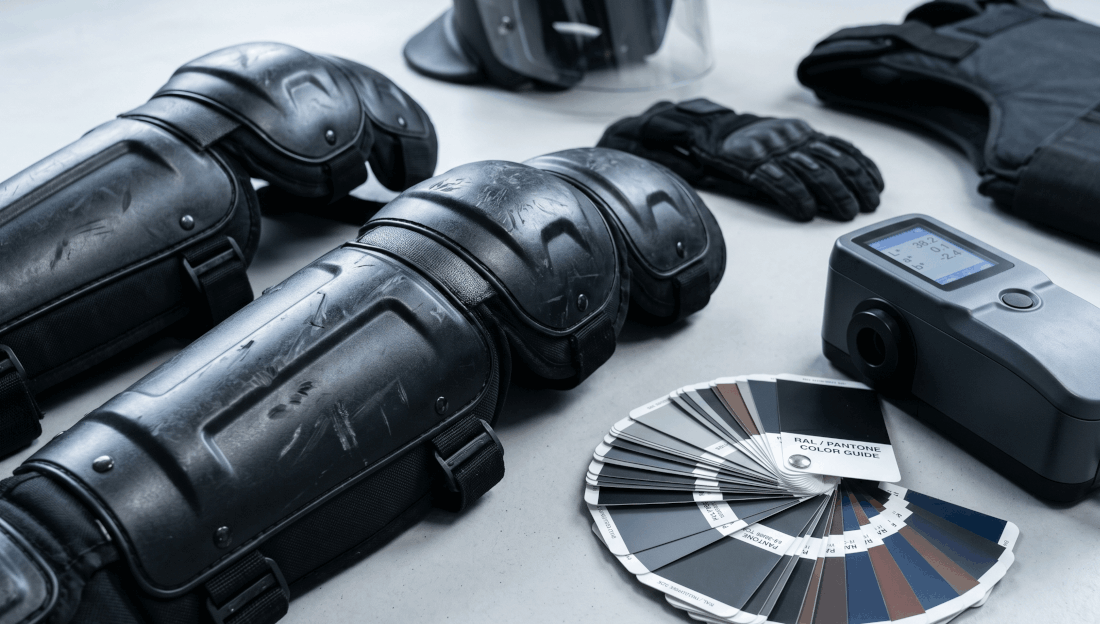
Why Testing Riot Gear Components Matters
For manufacturers of riot control suits, the performance of plastic components is directly linked to operator safety, liability, and brand reputation. When shin guards and thigh, shoulder, calf, and elbow protectors are hit by blunt objects, the rigid shells must absorb and dissipate impact energy without cracking or failing in a brittle way. Relying only on supplier datasheets is risky, because real performance depends both on the polymer and on the actual processing conditions.
This case study focuses on a polyamide material used to mould rigid protective shells for riot suits. The goal was to validate two critical aspects on the same material: notched Izod impact resistance and colour consistency of finished parts against a Pantone reference, under different lighting conditions.
The Polyamide and the Test Plan
The project started from a batch of polyamide granules supplied by the customer and used to inject rigid shell components for riot suits. The testing strategy was designed to capture both the intrinsic toughness of the material and its aesthetic behaviour once moulded. For impact performance, the laboratory prepared standard ISO specimens from the granules and performed Izod impact tests with a notch according to established standards. In parallel, three finished plastic parts (large, medium, small) were tested for colour against Pantone 19-0414 using an instrumental colour measurement method.
A key step in the impact test plan was drying the polyamide granules before injection moulding. Polyamides are hygroscopic, and excess moisture can cause hydrolysis during processing, reducing molecular weight and severely compromising toughness. In this case, the granules were dried for 4 hours at 90 °C before being moulded into ISO-standard specimens, ensuring that the measured impact performance reflected the potential of the material under controlled, good-practice conditions. On the colour side, finished parts were measured in terms of L*, a*, b*, C* and h under different illuminants, to assess both overall shade and behaviour in real-world lighting scenarios.
The customer’s internal specification required a minimum notched Izod impact strength of 120 J/m for the polyamide, expressed in terms compatible with their existing internal standards. The laboratory’s role was not just to execute tests, but to translate the results into forms that aligned with both ISO and ASTM practices, and to interpret what those results mean for riot gear applications.
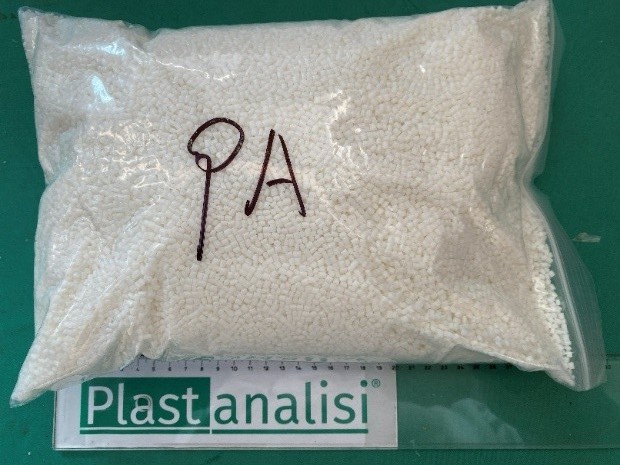
Batch of polyamide granules for riot gear.
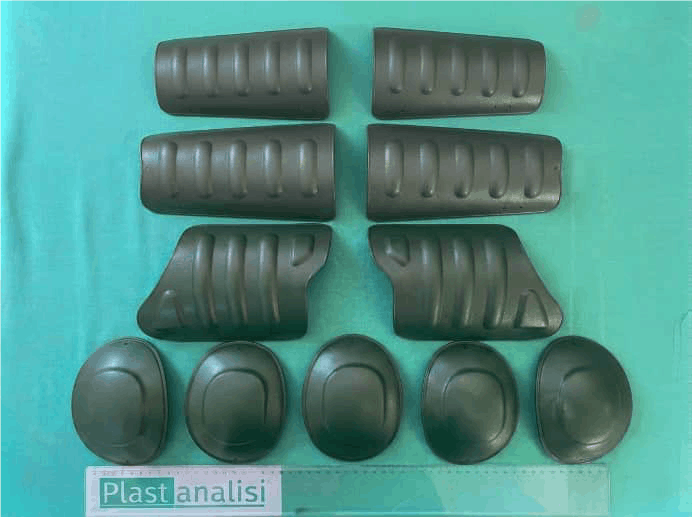
Polyamide protective shells.
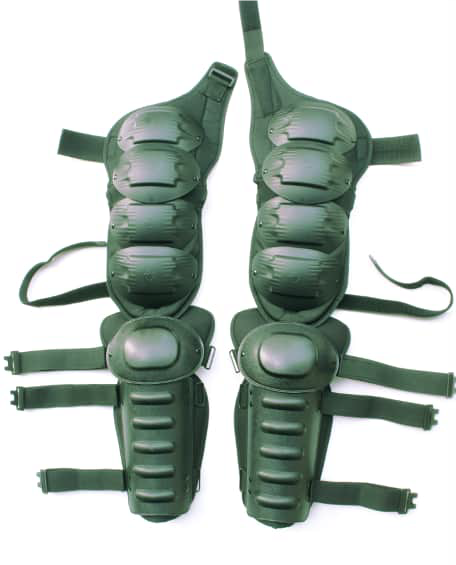
Polyamide protective shells.
Izod Impact Testing on Riot Suit Components
To assess impact resistance, the laboratory performed a notched Izod impact test on injection-moulded polyamide specimens produced from the dried granules. The test followed ISO 180:2023, and results were also converted into a format compatible with ASTM D256, so they could be easily compared with specifications and datasheets that use ASTM metrics. Using specimens with a standard notch makes it possible to simulate a conservative scenario, where edges, local defects, or thickness transitions generate stress concentrations similar to those that may occur in real shells.
The test plan included five repetitions on notched specimens, providing a small statistical sample to evaluate the repeatability of impact behaviour. For each specimen, the pendulum measured the energy absorbed at fracture. These values were then normalised to give results in kJ/m² under ISO representation and J/m in line with ASTM style reporting. Individual readings showed the typical variability of impact tests but stayed within a narrow range, indicating a material with consistent behaviour.
The key result for the customer was an average notched Izod impact resistance of about 151 J/m, clearly above the internal requirement of 120 J/m. In ISO units, this corresponds to roughly 47 kJ/m², confirming a high level of toughness for the polyamide under the test conditions. For design engineers, this safety margin allows them to size the shells considering not only nominal loads, but also localised blows and possible geometric defects, without necessarily over-dimensioning thickness and weight. For quality and procurement teams, the Izod protocol and the measured values provide a benchmark to compare future batches, material variants, or new suppliers.
At the same time, it is important to remember that the Izod test is performed on simple specimens and under defined environmental conditions, whereas real riot gear components may operate across different temperatures, humidity levels, and complex geometries. For this reason, Izod data represent a baseline pillar of validation, to be integrated, when needed, with tests on finished components and system-level functional trials.
Colour Control against Pantone 19-0414
While impact resistance ensures that the protective shells can withstand blows and blunt impacts, colour consistency is equally important for branding and perceived quality. In this project, the customer specified a reference to Pantone 19-0414, as the colour reference and supplied three finished components (large, medium, small). These parts were measured with a spectrophotometer in the CIELAB colour system.
For each part, the laboratory measured L* (lightness), a* (green-red axis), b* (blue-yellow axis), C* (chroma) and h (hue angle). Measurements were carried out under different illuminants, typically including daylight-like D65, incandescent-like A, and a fluorescent F11 condition. This approach reflects the reality that riot gear may be inspected or used under various lighting conditions: outdoor daylight, indoor artificial lighting, and mixed scenarios.
The reference Pantone values provided the target in terms of lightness and chromatic coordinates. The three parts showed a consistent trend: higher L* values compared to the Pantone, indicating that the parts were slightly lighter than the target shade. The a* and b* values also showed deviations that correspond to a subtle shift in hue and saturation relative to the standard. However, across the large, medium, and small parts, the differences between parts were relatively limited, suggesting good intra-batch consistency even if the overall colour was shifted from the Pantone reference.
These data help assess whether the difference is acceptable, based on defined tolerances and perceived visibility. They can also guide adjustments in pigment formulation, masterbatch dosing, or processing parameters. Measuring under multiple illuminants helps identify metamerism, where two colours match in one lighting condition but not in another, which is particularly relevant for equipment used both outdoors and indoors.
What This Means for Design and How the Lab Can Help
This case study shows how combining mechanical testing and colour evaluation on the same polyamide material provides a much richer and more reliable picture than checking either aspect in isolation. The notched Izod results demonstrate that, when properly dried and moulded, the polyamide can significantly exceed the required impact strength threshold, giving engineers confidence in the material’s ability to withstand blunt impacts and stress concentrations. At the same time, the colour measurements reveal how closely the finished parts track the specified Pantone shade, and highlight where adjustments in formulation or processing might be needed to tighten visual tolerances.
For design and R&D teams, the main takeaway is the value of integrating impact-critical tests and aesthetic control early in the development and industrialisation process. Testing starting from granules with controlled injection conditions allows meaningful comparisons across batches and suppliers. Testing finished parts for colour under multiple illuminants ensures that the equipment will look consistent in the environments where it is actually used. For quality and procurement, having standardised protocols and clear numerical criteria simplifies material qualification, change control, and long-term monitoring.
A specialised plastics testing laboratory like Plastanalisi can play a key role in structuring this type of validation. By combining Izod impact testing as part of our mechanical characterisation services with instrumental colour measurement and Pantone matching within our plastic materials characterisation offering, we bridge the gap between raw data and actionable design decisions. For manufacturers of impact‑critical polyamide components, working with Plastanalisi makes it possible to quantify safety margins and visual consistency, rather than relying on assumptions or generic datasheets.