


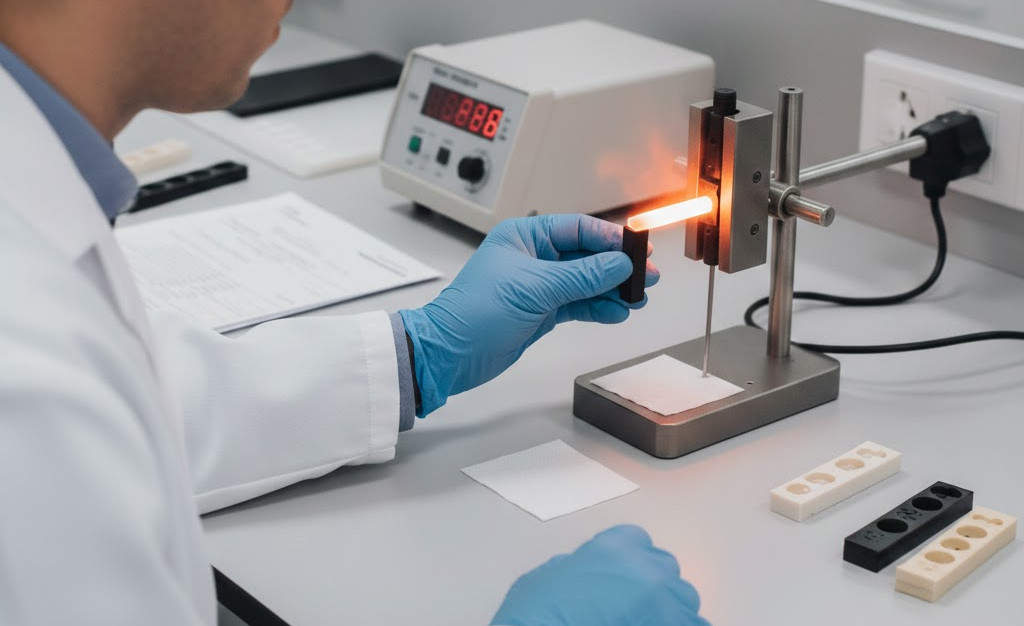
Fire safety compliance is often a critical bottleneck in selecting polymer materials for electrical and electronic applications. While UL-94 V0 certification has long been the global benchmark for flame-retardant plastics, European regulators require Glow Wire testing (IEC 60695) for household appliances—creating a compliance gap that frequently catches manufacturers off guard. Surprisingly, a material that achieves UL-94 V0 classification can fail Glow Wire requirements at temperatures as low as 750°C. This disconnect arises from fundamentally different ignition mechanisms: UL-94 evaluates response to direct flame exposure, while Glow Wire simulates conductive heating from malfunctioning electrical components. For engineering teams developing products for global markets, understanding these distinctions isn’t just academic; it directly impacts material costs, time-to-market, and regulatory approval.
UL-94 V0: The Free-Flame Standard and Its Technical Boundaries
Test Methodology and Classification
Developed by Underwriters Laboratories, the UL-94 standard classifies plastic materials based on their performance in controlled combustion scenarios using a Bunsen burner flame. The V0 classification represents the most demanding vertical burn rating and requires:
Specimen geometry: Five specimens measuring 125 mm × 13 mm at the minimum approved thickness
Flame application: A 20 mm blue flame applied to the specimen’s lower edge for 10 seconds, removed, then immediately reapplied for another 10 seconds once the specimen self-extinguishes
Pass criteria:
-
- Maximum 10 seconds of flaming combustion after each flame application
- Total flaming time ≤50 seconds across all 10 applications (5 specimens × 2 applications)
- No flaming drips that ignite cotton positioned 300 mm below
- No specimen burns up to the mounting clamp
- Glowing combustion must cease within 30 seconds after the second flame is removed
The V0 rating indicates rapid self-extinguishment and minimal flame propagation, making it the go-to specification for high-reliability applications such as automotive components, industrial enclosures, and consumer electronics housings.
Global Acceptance and Limitations
UL-94 V0 enjoys near-universal recognition across North America, Asia, and many international markets. Its harmonization with IEC 60695-11-10 and ISO 9772 reinforces its position as a de facto global standard. However, the test’s direct-flame methodology doesn’t replicate real-world failure modes where ignition originates from overheated electrical components rather than external flames. This limitation becomes particularly problematic for unattended appliances, where component malfunction can generate localized hot spots exceeding 700°C.
Glow Wire Testing: The European Regulatory Mandate
EC 60695 Test Suite
Defined in the IEC 60695 series, Glow Wire testing addresses the specific hazard of electrically heated elements contacting polymeric materials during abnormal operating conditions. Unlike UL-94’s flame-ignition model, Glow Wire simulates a resistor, coil, or connection point reaching critical temperatures due to electrical overload or mechanical failure. The test apparatus uses a nickel-chromium wire heated to precise temperatures and pressed against the test specimen with 1N force for 30 seconds.
The standard defines two critical metrics:
Glow Wire Flammability Index (GWFI) – IEC 60695-2-12
GWFI represents the highest temperature at which a material either will not ignite or, if ignition occurs, self-extinguishes within 30 seconds after wire removal without igniting the underlying tissue paper. For appliance applications, materials typically must demonstrate GWFI ≥850°C at the application’s wall thickness.
Glow Wire Ignition Temperature (GWIT) – IEC 60695-2-13
GWIT measures ignitability, defined as the temperature 25K higher than the maximum test temperature where three consecutive specimens show either no ignition or sustained flaming combustion for ≤5 seconds per flame event without complete specimen consumption. IEC 60335-1, the overarching safety standard for household appliances, mandates GWIT ≥775°C for unattended appliances carrying currents >0.2A.
Regulatory Enforcement in Europe
The 4th Edition of IEC 60335-1 (2020) intensified Glow Wire requirements, making these tests mandatory for plastic components near electrical connections. European Notified Bodies enforce these standards during CE marking certification, and non-compliance means denial of market access. The regulation specifically requires materials to pass GWIT 775°C or, alternatively, demonstrate GWFI >750°C with surrounding components rated UL-94 V-1 or better.
Technical Divergence: Why UL-94 V0 Materials Fail Glow Wire
Fundamental Mechanism Mismatch
The incompatibility between UL-94 V0 and Glow Wire performance originates from distinct ignition physics:
UL-94 V0 Success Factors: Achieving V0 performance requires rapid surface char formation and gas-phase flame inhibition when exposed to direct combustion. Halogenated flame retardants (brominated or chlorinated compounds) excel in this scenario by releasing radical scavengers that interrupt the combustion chain reaction. These systems demonstrate excellent free-flame suppression but perform poorly under conductive heating.
Glow Wire Failure Modes: When a 750-850°C metal element contacts plastic, heat transfer occurs through conduction rather than convection or radiation from a flame. This conductive heating:
- Penetrates rapidly into the material bulk
- Decomposes polymers at the interface before char can form
- Generates combustible gases under pressure
- Creates molten polymer that can ignite after wire removal
Halogenated systems often cannot prevent sustained smoldering or delayed ignition under these conditions, resulting in GWIT failure despite V0 classification.
Material-Specific Performance Data
Laboratory data reveals significant performance gaps across polymer families:
| Polymer Family | UL-94 V0 Achievable | Typical GWIT Performance | Key Challenge |
| Halogenated FR-ABS | Yes (1.5mm) | 650-700°C | Poor conductive heating resistance |
| Halogen-Free PA66 | Yes (0.4mm) | 750-800°C | Marginal GWIT compliance |
| Phosphorus FR-PBT | Yes (0.75mm) | 775-850°C | Good GWIT with optimized FR |
| Brominated FR-PS | Yes (1.6mm) | <700°C | Consistent GWIT failure |
| PC/ABS with BDP | Yes (1.5mm) | 725-775°C | Borderline performance |
This data demonstrates that material selection requires dual-test validation rather than assuming UL-94 V0 sufficiency.
Implications for Material Selection
Flame Retardant Chemistry
Phosphorus-Based Systems: Metal phosphinates and phosphate esters (such as BDP and RDP) demonstrate superior Glow Wire performance by promoting char formation through condensed-phase mechanisms. These systems work particularly well in polyesters, PA66, and PC/ABS blends. However, they typically require 15-20% loading, increasing material costs by 30-50% compared to halogenated alternatives.
Halogenated Systems: Brominated flame retardants remain cost-effective for achieving UL-94 V0 compliance but consistently underperform in Glow Wire scenarios. Their gas-phase radical scavenging mechanism provides minimal protection against conductive heating. For European appliance applications, halogenated systems should be avoided unless supplemented with phosphorus co-additives.
Inorganic Fillers: Aluminum hydroxide (ATH) and magnesium hydroxide (MDH) decompose endothermically, absorbing heat and forming protective ceramic layers. While effective for both tests, loadings exceeding 50% are often required, which can compromise mechanical properties and processability.
Timeline Considerations
Glow Wire testing demands substantially more resources than UL-94 evaluation:
| Parameter | UL-94 V0 | Glow Wire (GWIT/GWFI) |
| Test Duration | 2-3 days (including conditioning) | 5-10 days (temperature stepping) |
| Specimens Required | 10 per thickness | 30+ per temperature point |
| Failure Impact | Minor reformulation | Major FR system redesign |
The iterative nature of Glow Wire testing—where temperatures are adjusted in 50°C increments until failure—extends development timelines significantly. A material failing at 750°C may require complete flame retardant reformulation rather than simple loading adjustments.
Strategic Guidance for Multi-Market Compliance
Risk-Based Testing Strategy
Manufacturers should implement tiered testing protocols based on end-product application:
Tier 1 – Global Consumer Electronics (Non-Appliance):
- UL-94 V0 sufficient for most requirements
- Validate with 5-10 specimen sets across wall thickness range
- Cost: low
Tier 2 – Professional Equipment (Medical/Industrial):
- UL-94 V0 + optional GWFI screening at 650°C
- Identify early-stage Glow Wire sensitivity
- Cost: medium
Tier 3 – European Household Appliances:
- Mandatory GWIT 775°C + GWFI 850°C per IEC 60335-1
- UL-94 V0 validation as secondary criteria
- Require supplier certificates from ISO/IEC 17025 accredited labs
- Cost: high
Supplier Qualification Framework
When sourcing flame-retardant polymers, procurement teams should require:
- Dual-test certificates: UL-94 V0 rating AND GWIT/GWFI values at relevant thicknesses
- Test method transparency: Specify IEC 60695-2-12/13 versions (2021 editions include critical refinements)
- Batch consistency data: Glow Wire performance can vary ±30°C between production lots due to FR dispersion
- Alternative material options: Pre-qualified phosphorus-based grades with documented Glow Wire margins.
Conclusion: Navigating the Compliance Dichotomy
The gap between UL-94 V0 and Glow Wire testing reflects fundamentally different fire safety philosophies: free-flame resistance versus component-overheat protection. For manufacturers targeting European appliance markets, UL-94 V0 certification is necessary but not sufficient evidence of compliance. The IEC 60335-1 mandate for GWIT 775°C introduces material performance requirements that many traditional V0 formulations—particularly halogenated systems—simply cannot satisfy.
Material suppliers and testing laboratories must educate engineering teams on this distinction, emphasizing that flame retardant selection should be driven by actual end-product ignition scenarios rather than historical standards preferences. Phosphorus-based and advanced inorganic systems, while more expensive, provide the dual-test robustness required for global market access. The 30-50% cost premium for Glow Wire-compliant materials is modest compared to the expense of late-stage redesign, retooling, and delayed product launches.
Ultimately, successful polymer selection demands early-stage Glow Wire validation, supplier transparency on test protocols, and design practices that accommodate the conductive heating mechanisms these standards evaluate. As regulatory harmonization efforts continue, the industry trend favors IEC 60695’s applied-physics approach over traditional flame tests, making Glow Wire competence a strategic imperative for forward-looking manufacturers.
Need Expert Guidance on Flammability Testing?
Navigating the complexities of UL-94 V0 and Glow Wire testing doesn’t have to be overwhelming. Our laboratory’s experienced technical team specializes in polymer flammability analysis and can help you determine the right testing strategy for your specific application. Whether you need consultation on material selection, assistance interpreting test results, or want to schedule flammability testing for your materials, we’re here to support your product development journey.
Contact our technical specialists today to discuss your flammability testing requirements and ensure your materials meet both regional and global compliance standards. We’ll help you avoid costly late-stage redesigns and get your products to market faster.
Author Note: This analysis reflects current IEC 60695 and UL-94 standards as of January 2026. Always verify the latest edition requirements with your notified body prior to certification testing.