


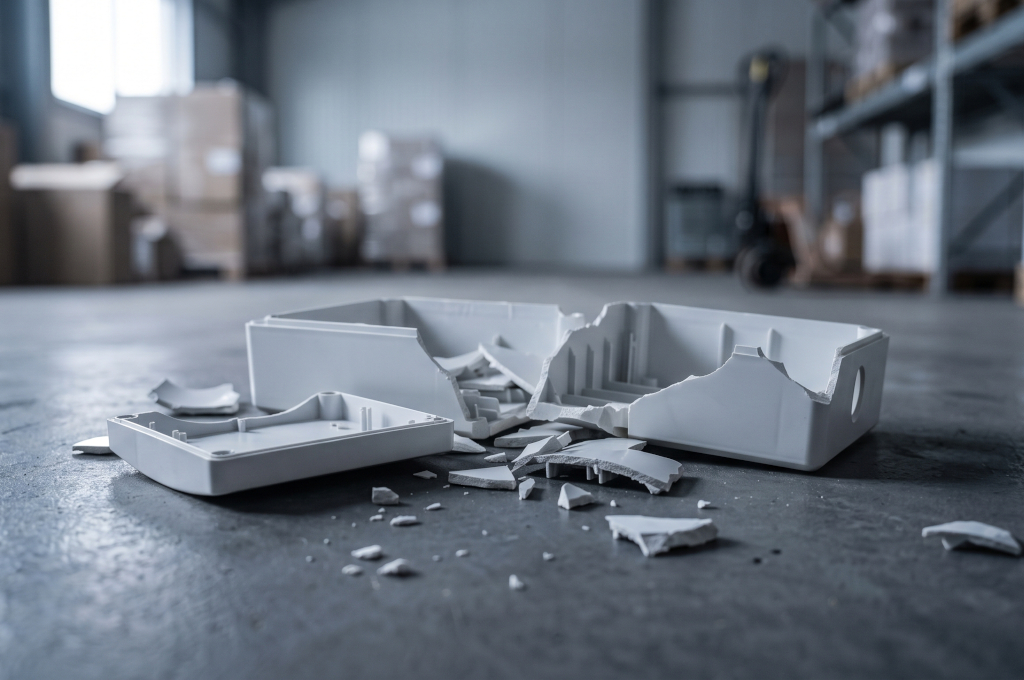
A plastic housing that survives years of handling on a factory floor can crack the instant it is dropped on a loading dock in January. For engineers working with polypropylene, this is not a random defect or a sign of poor manufacturing. It is a predictable, well-documented material behavior rooted in polymer physics, and it catches design and quality teams off guard more often than it should.
Polypropylene (PP) is one of the most widely used thermoplastics in the world, prized for its low cost, chemical resistance, and light weight. But it has a well-known weakness: its impact toughness drops sharply as temperatures fall, and below a certain threshold, parts that were perfectly ductile at room temperature become brittle enough to shatter like glass under a single impact. Understanding why this happens, and how to test for it, is essential for manufacturers whose products will see cold storage, winter shipping, or outdoor use.
The problem: cold weather field failures
Field failures follow a familiar pattern. A component passes every quality check at the factory and ships out without issue. Then, during a cold winter delivery, a customer drops the box, or a technician installs the part outdoors, and it cracks or fractures into pieces rather than deforming or denting.
This is especially problematic for injection-molded PP components used in appliances, automotive interiors, packaging, and outdoor equipment, where the material is chosen precisely for its low weight and cost advantages. When these parts fail in the cold, the consequences range from warranty claims and product recalls to safety concerns, particularly in automotive or structural applications where impact resistance is a functional requirement, not just a cosmetic one.
The root cause is a material property that does not show up in a standard room-temperature datasheet: the glass transition temperature, or Tg, of polypropylene.
Technical background: glass transition and the ductile-brittle transition
Every amorphous or semi-crystalline polymer has a glass transition temperature, the point at which its amorphous molecular chains shift from a mobile, rubbery state to a rigid, glassy one. Above Tg, polymer chains have enough thermal energy to slide and rearrange under stress, allowing the material to absorb energy through plastic deformation. Below Tg, that molecular mobility freezes out, and the material can no longer dissipate impact energy through yielding. Instead, energy concentrates at defects and propagates as a crack almost instantly.
For polypropylene, the glass transition temperature sits close to 0°C, though the exact value depends on grade, crystallinity, and comonomer content, with reported values ranging roughly from -10°C to +10°C. This is unusually high compared to other common thermoplastics; polyethylene, for example, has a Tg well below -70°C, one reason PE film stays flexible in a freezer while a PP part in the same freezer can become dangerously brittle.
This proximity to typical ambient and shipping temperatures makes PP’s cold-weather behavior operationally significant. A part that behaves ductile at 20°C can cross into brittle territory during a single cold night in transit, with no visible change to the material and no warning before failure.
Ductile-to-Brittle transition is not a single fixed number
It is a common misconception that PP simply “becomes brittle at 0°C.” The ductile-to-brittle transition temperature (Tbd) depends heavily on test geometry and loading conditions. Unnotched specimens show a transition between 0°C and 20°C, while notched specimens, which better simulate real-world stress concentrators like sharp corners, ribs, or molded-in defects, show a transition at significantly higher temperatures under impact loading. A notch, weld line, or sink mark can push the effective brittleness threshold of a PP part far above its intrinsic Tg, making geometry as important as material selection for cold-weather performance.
Crystallinity and molecular weight further shift this transition. Higher crystallinity raises the yield stress, pushing the transition upward, while higher molecular weight tends to lower it by increasing fracture stress. Two PP resins with identical nominal grades can therefore behave very differently in a cold impact test, depending on subtle differences in chain length and crystalline structure shaped by processing conditions during injection molding.
How the failure mechanism works in practice
At the microstructural level, polypropylene’s cold-brittleness ties directly to how it absorbs mechanical energy. Above its glass transition, PP dissipates impact energy through shear yielding, a deformation mode where chains in the amorphous regions slide past one another, spreading stress over a larger volume before fracture. Below Tg, this shear mobility disappears, and the dominant mode shifts to microvoiding, the formation of tiny voids that quickly coalesce into cracks under stress.
This shift from shear-dominated to void-dominated fracture explains why cold PP failures look so different from room-temperature ones. A part failing at room temperature typically shows whitening, necking, or localized deformation near the fracture point. A part failing below Tg shatters cleanly, often into multiple fragments, with little to no visible plastic deformation at the crack surface, a signature that failure analysts look for in field returns.
Testing the Ductile-Brittle transition in the lab
Because this failure mode is temperature-dependent and highly sensitive to notch geometry, standard room-temperature testing cannot qualify PP parts for cold-climate use. Laboratories evaluate impact behavior using notched Izod impact testing (ISO 180) together with tensile and flexural testing in a climatic chamber, run across a range of temperatures rather than at a single ambient condition.
Standardized specimens, often notched to simulate a stress concentrator, are conditioned at a target temperature (commonly 23°C, 0°C, -20°C, and -40°C) and struck with a calibrated pendulum, while parallel tensile and flexural runs in the climatic chamber capture how stiffness and elongation shift at the same temperatures. The energy absorbed before fracture in the Izod test is recorded in J/m. Typical values illustrate the scale of the effect: notched Izod impact strength for standard PP homopolymer ranges from about 40 to 100 J/m, while impact copolymer grades formulated for toughness can reach 150 to 600 J/m at room temperature, values that fall substantially as test temperature drops toward and below the glass transition.
Standards bodies specifically call out low-temperature conditioning for this reason: specimens are conditioned in a freezer at the target temperature and tested within seconds of removal, since PP can begin warming and regaining ductility almost immediately once removed from a cold environment. This tight window is why cold-impact testing demands disciplined laboratory procedure, not just a freezer and a pendulum.
It’s worth noting that Izod results are not directly interchangeable with other impact metrics like dart-drop testing used for films, since each method applies stress in a different geometry and loading mode. Specifying the correct test method for the product’s real-world stress condition, whether a falling object, a bending load, or an edge impact, is a step often overlooked during material qualification.
Application examples across industries
Automotive: Exterior trim, bumper fascias, and under-hood components molded in PP or PP-based compounds must withstand impact in sub-zero climates, whether from road debris, minor collisions, or handling during a winter service visit. Many automotive PP grades are impact-modified specifically to push the brittle transition well below the vehicle’s expected operating range.
Appliances: Refrigerator components, freezer door liners, and internal housings are a textbook case of PP operating near or below its own glass transition during normal service. A liner that cracks after a few winters of thermal cycling is often experiencing exactly the ductile-to-brittle degradation described above, compounded by long-term thermal-oxidative aging.
Packaging and logistics: Reusable crates, pallet boxes, and protective packaging made from PP are routinely exposed to unheated trucks, warehouses, and outdoor storage during winter months. A container that survives thousands of warm-weather handling cycles can fail on its first cold-weather drop if the resin grade was not tested for low-temperature impact.
Industrial equipment and machinery guards: Safety guards, housings, and enclosures made from PP for outdoor or unheated industrial environments carry real safety implications if they shatter under impact rather than absorbing energy, particularly where the guard protects personnel from moving parts or debris.
Limits and operational considerations
Cold-impact behavior in PP cannot be fully predicted from a datasheet Tg value alone. Real parts include weld lines, wall thickness transitions, gate locations, and residual stresses from molding, all of which shift the effective brittle-ductile transition away from the value measured on an idealized laboratory specimen. Additive packages, including impact modifiers, nucleating agents, and mineral fillers, also change low-temperature performance in grade- and formulation-specific ways, so results from one PP compound cannot be safely extrapolated to another, even within the same nominal material family.
There is also a practical testing challenge: the transition between ductile and brittle behavior is not a sharp cutoff but a statistical distribution of failure probabilities across a temperature range, particularly near the transition zone. This is why serious qualification programs test multiple specimens at several temperatures rather than relying on a single pass/fail point, and why standards intentionally avoid specifying one universal test temperature for all PP applications.
How our laboratory can help
Identifying and preventing cold-temperature impact failures requires more than a single test at ambient conditions. Our laboratory performs notched Izod impact testing (ISO 180), along with tensile and flexural testing in a climatic chamber from -40°C to +200°C, giving manufacturers a real picture of how their PP parts and resin grades will behave in cold storage, winter shipping, or outdoor service.
We combine impact testing with DSC thermal analysis, microscopy, and failure analysis to determine not just whether a part will fail in the cold, but why, whether the cause lies in resin selection, part geometry, processing conditions, or degradation from recycled content. If your products are experiencing unexplained cracking in cold climates, or if you need to qualify a new PP grade before it reaches a winter market, our team can design a testing program tailored to your application and help you build the data needed to prevent field failures before they happen.